

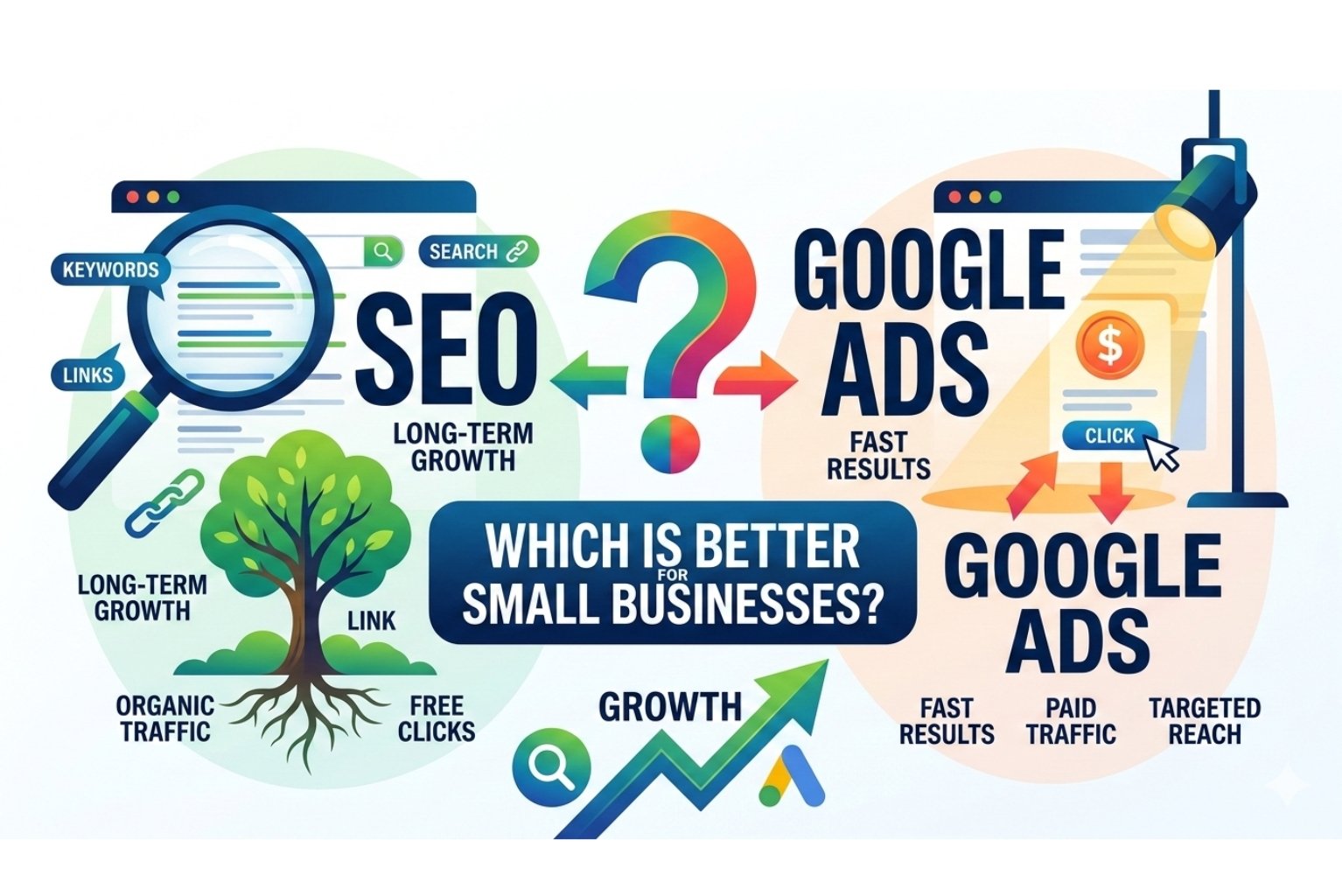
One of the most common — and costly — marketing decisions small business owners face in 2026 is this: should I invest in SEO or Google Ads?
It sounds like a simple question. But make the wrong call, and you could burn through thousands of dollars with little to show for it. Invest in SEO when you desperately need leads next month, and you’ll be waiting. Dump your budget into Google Ads without a proper strategy, and you’ll pay for clicks that never convert.
The honest answer is that the right choice depends entirely on your goals, your budget, and your timeline. This guide breaks it all down so you can make a confident, data-informed decision — and stop guessing.
What Is SEO (Search Engine Optimization)?
SEO is the practice of improving your website so it ranks higher in organic (unpaid) search results on Google. When someone searches “emergency plumber San Diego” and your business appears on the first page without you paying per click, that’s SEO doing its job.
Effective SEO for small businesses includes several interconnected strategies. On-page optimization ensures your website content, headings, and structure signal relevance to search engines. Technical SEO addresses site speed, mobile-friendliness, and crawlability. Content marketing builds authority by answering the questions your customers are already asking. And local SEO — particularly Google Business Profile optimization — puts your business on the map, literally, for nearby searchers.
The core benefits of SEO for small businesses:
- Sustainable, compounding traffic — rankings you earn today keep delivering results for months or years
- Trust and credibility — organic results are trusted more than ads; 70–80% of users ignore paid listings and click organic results
- Lower long-term cost per lead — once you rank, traffic is essentially free
- Compounding growth — each piece of optimized content adds to your authority, making future rankings easier to achieve
SEO is a long-term asset. Think of it like buying property — there’s an upfront investment, but the value appreciates over time.
What Are Google Ads (PPC Advertising)?
Google Ads is a paid search advertising platform where your business pays to appear at the top of search results for specific keywords. You bid on terms like “best HVAC company near me,” and when someone searches that phrase, your ad appears — but you only pay when someone clicks. This is the pay-per-click (PPC) model.
Google Ads offers immediate visibility. The day your campaign goes live, your business can appear at the top of Google for your target keywords. For small businesses that need leads now — a new startup, a seasonal business, or a company launching a new service — this speed is invaluable.
The core benefits of Google Ads for small businesses:
- Fast results — traffic starts the day your campaign launches
- Highly targeted reach — target by location, device, time of day, search intent, and demographics
- Measurable and testable — you can A/B test ads, track every conversion, and adjust in real time
- Scalable — increase budget when campaigns perform, pull back when they don’t
The catch? The moment you stop paying, the traffic stops. Unlike SEO, PPC doesn’t build a permanent asset.
SEO vs. Google Ads: Key Differences
| Factor | SEO | Google Ads |
|---|---|---|
| Cost | Ongoing investment (content, optimization) | Pay per click; costs scale with competition |
| Time to results | 3–9 months typically | Immediate |
| Sustainability | Long-term; rankings persist | Stops when budget stops |
| Trust factor | High; users trust organic results | Lower; users know it’s an ad |
| Click-through rate | Higher for top organic positions | Lower average CTR vs. top organic |
| ROI over time | Increases as authority builds | Consistent but flat; no compounding effect |
| Competition impact | Competitors can’t outbid you | Higher competition = higher cost per click |
Neither channel is universally better. They serve different purposes at different stages of business growth.
Long-Term vs. Short-Term Results: Which Timeline Is Right for You?
This is where most small business owners make their biggest mistake — choosing a channel based on what sounds better rather than what matches their actual situation.
SEO is your long-term growth engine. A well-executed SEO strategy typically begins producing meaningful results in 3–6 months, with compounding returns over the following years. A local roofing company that invests in local SEO services consistently for 12 months can realistically dominate their local search results — and those rankings generate leads indefinitely without ongoing ad spend.
Google Ads is your short-term accelerator. A new e-commerce store launching a product line can’t wait 6 months for organic traffic. Paid search advertising gets the product in front of buyers immediately while the SEO foundation gets built in parallel.
Consider these real-world scenarios:
- Local plumber — Needs calls today. Start with Google Ads to generate immediate leads, then build local SEO for sustainable inbound traffic over the following year.
- New startup — Has no brand authority or organic rankings. Google Ads provides instant visibility while content and SEO build long-term credibility.
- Established local service provider — Already has some organic presence. Double down on SEO to reduce dependence on paid advertising and lower cost per acquisition over time.
- E-commerce store — Needs both: Google Shopping ads for immediate product visibility and SEO-optimized category pages for long-term organic traffic.
Cost Comparison: Which Is More Affordable?
Cost is where small business owners often get surprised — in both directions.
Google Ads costs vary significantly by industry. In competitive markets like legal services, insurance, or home renovation, cost-per-click can range from $15 to $50+. A modest local campaign for a service business might run $800–$2,500 per month in ad spend, before factoring in management fees.
SEO investment for a small business typically ranges from $750–$2,500 per month for professional services, depending on market competitiveness and the scope of work required.
At first glance, the costs look similar. The difference is in what you’re buying. With Google Ads, every dollar buys a click — and nothing more. With SEO, every dollar invested builds lasting authority that continues generating returns long after the work is done. A business that spends $1,500/month on SEO for 18 months has an asset. A business that spends $1,500/month on Google Ads for 18 months has 18 months of traffic — and nothing the moment the budget stops.
The hidden costs nobody warns you about:
- Poorly managed Google Ads campaigns that drive clicks but not conversions (bad landing pages, wrong keywords, no negative keyword lists)
- Cheap SEO services that use outdated tactics and trigger Google penalties
- Ignoring conversion rate optimization — even perfect traffic doesn’t help if your website doesn’t convert
When Should Small Businesses Use Both Together?
The smartest digital marketing strategy for most small businesses in 2026 isn’t choosing between SEO and Google Ads — it’s using both strategically.
Here’s how a hybrid approach works in practice. Launch Google Ads immediately to generate leads and revenue while your SEO foundation is being built. As your organic rankings improve over 6–12 months, gradually reduce ad spend on keywords where you now rank organically — reallocating that budget to more competitive terms or new markets.
PPC data also supercharges your SEO strategy. The keywords that drive conversions in your Google Ads campaigns are exactly the keywords you should be targeting with SEO content. Instead of guessing what your audience searches for, you have real conversion data telling you precisely what drives revenue.
Add retargeting to the mix — serving ads to people who visited your site but didn’t convert — and you have a comprehensive digital marketing strategy that captures demand at every stage of the buyer journey.
Common Mistakes Small Businesses Make
Even with the right channel, strategy execution determines results. These are the mistakes that quietly drain marketing budgets:
- Stopping SEO too early — Businesses give up after 3 months because they don’t see results, not realizing that months 6–12 are where the compounding returns materialize
- Running Google Ads to an unoptimized website — Paying $3 per click to send traffic to a slow, confusing, or unconvincing landing page is money directly wasted
- Not tracking conversions — If you don’t know which channel, campaign, or keyword is generating actual customers (not just clicks), you cannot make intelligent budget decisions
- Hiring based on price, not strategy — The cheapest SEO or PPC agency is almost always the most expensive in the long run
Why Strategy Matters More Than the Channel
The channel — SEO or Google Ads — is just a vehicle. Strategy is the engine. A well-managed Google Ads campaign with precise targeting, conversion-optimized landing pages, and ongoing data analysis will dramatically outperform a poorly run SEO effort, and vice versa.
What moves the needle for small businesses is a clear understanding of their customer acquisition funnel, smart allocation of budget across channels, and continuous optimization based on real performance data. That requires expertise, not guesswork.
About Apps Web Dev LLC
Apps Web Dev LLC is a San Diego-based web design and digital marketing agency specializing in SEO, Google Ads management, and conversion-optimized websites for small businesses and local service providers across the United States. Their data-driven approach focuses on one outcome: measurable ROI for their clients.
Whether you need a complete local SEO strategy, a Google Ads campaign built for conversions, or a custom digital marketing plan tailored to your business goals and budget, Apps Web Dev LLC delivers strategies that generate real results — not vanity metrics.
Ready to Stop Guessing and Start Growing?
Your competitors are making strategic decisions about SEO and Google Ads right now. Every month without a clear digital marketing strategy is revenue walking out the door.
Apps Web Dev LLC offers a free marketing strategy consultation for qualifying small businesses. In one conversation, you’ll get a clear, honest recommendation on whether SEO, Google Ads, or a hybrid approach makes sense for your specific business — along with a free audit of your current website and any existing campaigns.
No hard sell. No generic advice. Just a strategic roadmap built around your goals, your market, and your budget.
Frequently Asked Questions
Is SEO better than Google Ads for small businesses?
Neither is universally better — it depends on your timeline and goals. SEO delivers sustainable, long-term organic traffic that compounds over time and builds lasting authority. Google Ads delivers immediate, targeted visibility but stops the moment your budget does. For most small businesses, the optimal approach is a hybrid strategy: use Google Ads for quick lead generation while building SEO as a long-term asset. If budget forces a choice, businesses with a 6–12 month runway and stable revenue should prioritize SEO. Businesses needing leads immediately should start with PPC.
How long does SEO take to show results?
Most small businesses begin seeing meaningful organic traffic improvements within 3–6 months of consistent, professional SEO work. Reaching competitive first-page rankings for high-value keywords typically takes 6–12 months depending on competition, domain age, and the quality of the strategy. Local SEO results — particularly Google Business Profile visibility — often appear faster, sometimes within 6–8 weeks. SEO is not a quick fix, but the results build on themselves. The businesses that start today are the ones dominating search results a year from now.
How much should a small business spend on Google Ads?
A realistic starting budget for Google Ads for small businesses is $500–$1,500 per month in ad spend, plus management fees if working with an agency. Highly competitive industries like legal, medical, or home services may require $2,000–$5,000/month to compete effectively. The critical factor isn’t the budget size — it’s the conversion efficiency of your campaigns. A $1,000/month campaign with well-optimized landing pages and precise targeting will consistently outperform a $3,000/month campaign run without strategy. Always track cost per acquisition, not just cost per click.
Can SEO and PPC work together?
Absolutely — and for most growth-focused small businesses, combining both is the smartest digital marketing strategy available. Google Ads delivers immediate traffic and conversion data, while SEO builds long-term organic authority. PPC keyword performance data directly informs which terms to target with SEO content. Over time, as organic rankings improve, you can reduce paid spend on those keywords and reallocate budget to new opportunities. The two channels reinforce each other when managed with a unified strategy.
Which has better ROI: SEO or paid ads?
Over a 12–24 month horizon, SEO consistently delivers a higher return on investment for most small businesses. Once organic rankings are established, traffic is essentially free — resulting in a dramatically lower cost per lead over time. Google Ads provides a more predictable, consistent ROI but doesn’t improve or compound with time. The cost per acquisition stays relatively flat regardless of how long you run campaigns. For businesses with the runway to invest in SEO, the long-term ROI advantage is significant. For businesses needing immediate returns, Google Ads provides faster, more measurable short-term results.