

Most small businesses don’t fail because of a bad product or poor customer service. They fail because of poor marketing decisions — and in 2026, those decisions are more consequential than ever.
Digital marketing has never been more competitive. Consumers have more choices, attention spans are shorter, and the cost of getting it wrong keeps rising. A poorly managed Google Ads campaign, a website that drives visitors away, or a complete absence from local search results can quietly cost a small business tens of thousands of dollars in lost revenue every year.
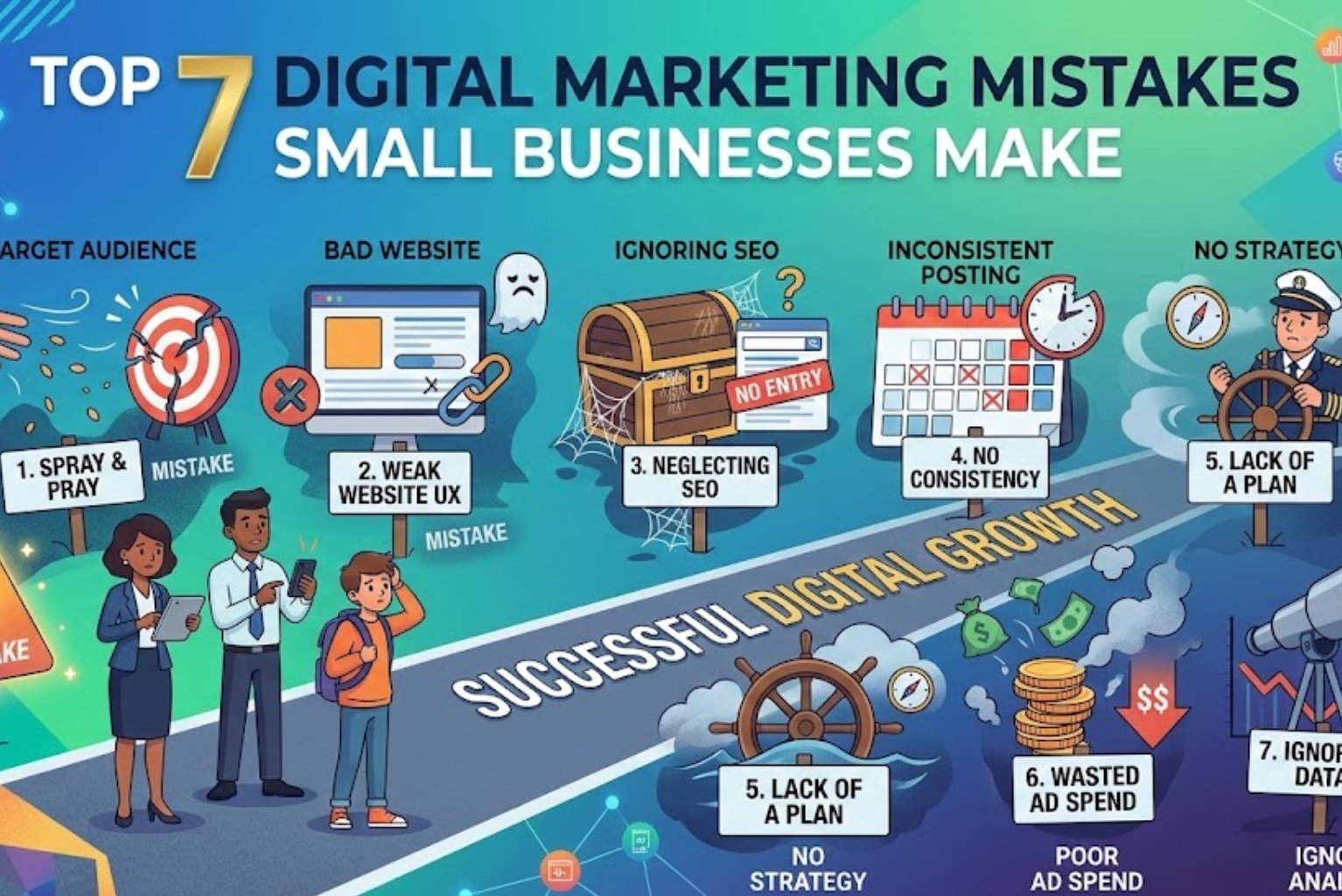
The good news? Most of these mistakes are fixable — once you know what to look for. Here are the top 7 digital marketing mistakes small businesses make, and exactly how to correct them.
Mistake #1: Ignoring Local SEO
If your business serves customers in a specific geographic area and you’re not actively investing in local SEO services, you’re essentially invisible to the people most likely to buy from you.
Consider this: 46% of all Google searches have local intent. When someone searches “electrician near me” or “best pizza in San Diego,” Google serves a Map Pack — three prominently displayed local businesses — before any other organic results. Businesses that aren’t optimized for local search simply don’t appear there, no matter how good their services are.
An unoptimized Google Business Profile, missing local citations, and no location-specific content are three of the most common reasons small businesses lose local customers to competitors every single day.
How to Fix It
- Claim and fully optimize your Google Business Profile — complete every field, add photos, select accurate categories, and post updates regularly
- Build consistent local citations (your business name, address, and phone number) across directories like Yelp, Apple Maps, and industry-specific platforms
- Actively collect and respond to customer reviews — they directly influence both local rankings and buying decisions
- Create location-specific landing pages if you serve multiple areas, targeting local search terms relevant to each market
Mistake #2: Not Tracking Conversions
Running digital marketing campaigns without conversion tracking is the equivalent of spending money on advertising and never checking whether it worked. Shockingly, a large percentage of small businesses do exactly this.
Without proper conversion tracking, you have no idea which campaigns are generating actual leads, which keywords are driving phone calls, or which landing pages are convincing visitors to take action. You’re making budget decisions based on impressions and clicks — not revenue.
How to Fix It
- Set up goal tracking in Google Analytics 4 for all key actions: form submissions, phone calls, purchases, and appointment bookings
- Install Google Tag Manager to manage tracking scripts efficiently without requiring constant developer involvement
- Use call tracking software to attribute inbound phone calls to specific campaigns or keywords
- Monitor cost per lead — not just cost per click — to understand true campaign profitability
Mistake #3: Poor Website UX (User Experience)
You can have the best SEO in your market and a perfectly optimized Google Ads campaign, and still lose business every day — if your website fails the people who land on it.
Website UX optimization is consistently undervalued by small businesses. Slow load times, confusing navigation, buried contact information, weak calls-to-action, and layouts that break on mobile devices all create friction that pushes potential customers toward competitors. Research shows that 88% of online consumers are less likely to return to a website after a bad user experience.
How to Fix It
- Improve website speed by compressing images, using a CDN, and eliminating render-blocking scripts — aim for a load time under 2.5 seconds
- Simplify navigation so that any visitor can find what they’re looking for within two clicks
- Place strong, specific calls-to-action above the fold on every key page — “Get a Free Quote” converts better than “Learn More”
- Implement mobile-first design principles; your site should be flawless on a smartphone screen before anything else
Mistake #4: Running Ads Without a Strategy
Boosting a Facebook post or launching a Google Ads campaign without a clear strategy isn’t marketing — it’s gambling. And the house almost always wins.
A poor Google Ads strategy is one of the most common ways small businesses waste marketing budget. Broad keyword targeting, no negative keyword lists, ads pointing to a homepage instead of a dedicated landing page, and zero A/B testing are mistakes that can drain hundreds or thousands of dollars with minimal return.
How to Fix It
- Define a specific, measurable goal for every campaign before spending a single dollar — leads, calls, purchases, or appointments
- Build funnel-based campaigns where ads, landing pages, and follow-up sequences are aligned with where the customer is in their buying journey
- Create dedicated landing pages for each campaign that match the ad’s message and have one clear conversion objective
- Use A/B testing on headlines, CTAs, and landing page layouts, and let data — not intuition — determine what runs
Mistake #5: Not Using a CRM System
Generating leads is only half the battle. What happens to those leads after they come in determines whether marketing spend actually turns into revenue.
Many small businesses rely on email inboxes, sticky notes, and memory to manage leads and customer follow-ups. Leads fall through the cracks. Follow-ups don’t happen. Customers who were ready to buy go with a competitor who responded faster. A CRM for small businesses solves this systematically.
How to Fix It
- Implement a CRM platform — options like HubSpot, Zoho, or GoHighLevel offer small business-appropriate pricing and functionality
- Automate initial follow-up sequences so every lead receives a response within minutes, not hours
- Build a visual sales pipeline so you always know exactly where each prospect stands in the buying process
- Use CRM data to improve lead nurturing — different messages for leads at different stages dramatically improve close rates
Mistake #6: Inconsistent Branding and Messaging
When your website says one thing, your Google Business Profile says another, and your social media posts feel like they were written by a completely different company, potential customers notice — even if they can’t articulate why. Inconsistency erodes trust, and trust is the foundation of every purchasing decision.
Weak or inconsistent brand identity makes small businesses look amateurish, even when their actual services are excellent. A confused value proposition — failing to clearly communicate who you serve, what you do, and why you’re different — costs businesses opportunities at every stage of the funnel.
How to Fix It
- Develop a clear brand positioning statement: who you serve, what problem you solve, and what makes you different from alternatives
- Align messaging, tone, and visual identity across your website, social profiles, Google listing, and any advertising
- Create a basic brand style guide — even a one-page document covering logo usage, color palette, fonts, and tone of voice creates remarkable consistency
- Audit every customer touchpoint annually to ensure messaging hasn’t drifted
Mistake #7: Expecting Instant Results
Digital marketing is not a vending machine. Insert money, receive customers. It requires strategy, patience, and consistent execution — and small businesses that abandon their lead generation strategy after 60 days because they didn’t see immediate returns consistently leave long-term ROI on the table.
SEO takes time to build authority. Google Ads campaigns require data accumulation and optimization before they perform at their best. Content marketing compounds over months and years. Treating marketing spend as a one-time test rather than a long-term investment leads to a cycle of starting, stopping, and never realizing meaningful returns.
How to Fix It
- Set realistic KPIs from day one — establish what success looks like at 90 days, 6 months, and 12 months, and build your expectations around those timelines
- Commit to a 6–12 month marketing strategy before making major pivots based on early data
- Review performance monthly and optimize based on data, but distinguish between normal early-stage variance and genuine underperformance
- Work with an agency or advisor who will set honest expectations and explain the “why” behind every recommendation
The Real Problem: No Unified Strategy
Looking at these seven mistakes together, a clear pattern emerges. Most of them don’t happen because business owners are careless — they happen because digital marketing is being treated as a collection of separate tactics rather than one cohesive small business marketing strategy.
Running ads here. Posting on social media there. Maybe doing a little SEO. No connection between channels, no shared data, no unified message, and no clear picture of what’s actually working.
The businesses growing consistently in 2026 are the ones with integrated strategies — where SEO, paid advertising, website performance, CRM, and branding all work together toward the same revenue goals.
About Apps Web Dev LLC
Apps Web Dev LLC is a full-service digital marketing and web development agency based in San Diego, California, serving small businesses and local service providers across the United States. Their team specializes in custom web development, local SEO services, Google Ads management, and conversion-focused digital marketing strategies — all built around one priority: measurable ROI for their clients.
From building high-performance websites to managing data-driven paid campaigns, Apps Web Dev LLC delivers integrated digital solutions that generate real business growth, not vanity metrics.
Is Your Marketing Working as Hard as It Should Be?
If any of the mistakes in this article sounded familiar, you’re not alone — and you don’t have to figure it out by yourself.
Apps Web Dev LLC offers a free marketing audit for qualifying small businesses. In one focused session, their team will review your current website performance, SEO standing, ad campaigns, and conversion setup — then deliver a clear, prioritized action plan tailored to your specific business and budget.
No generic advice. No upsell pressure. Just a strategic roadmap built around your growth goals.
Frequently Asked Questions
What is the biggest digital marketing mistake small businesses make?
The single most damaging mistake is operating without a unified strategy. Most small businesses run disconnected tactics — some ads here, occasional social posts there — with no shared goal, no conversion tracking, and no way to measure what’s actually working. This leads to wasted budget and inconsistent results. A cohesive digital marketing strategy that aligns SEO, paid advertising, website performance, and lead nurturing around clear revenue goals consistently outperforms any collection of isolated tactics, regardless of budget size.
How important is local SEO for small businesses?
For any business that serves a geographic area, local SEO is among the most valuable marketing investments available. Nearly half of all Google searches include local intent, and the businesses that appear in Google’s Map Pack — the three local results displayed prominently at the top of the page — capture a disproportionate share of clicks and calls. An optimized Google Business Profile, consistent local citations, and genuine customer reviews can dramatically increase a local business’s visibility and inbound lead volume without ongoing ad spend.
Why is conversion tracking essential for small businesses?
Without conversion tracking, marketing decisions are based on guesswork rather than data. A business might be spending $2,000 per month on Google Ads and assume it’s working because they’re getting clicks — but without tracking which clicks turn into calls, form submissions, or sales, there’s no way to know if that spend is profitable. Conversion tracking connects marketing activity to actual business outcomes, enabling smarter budget allocation, better campaign optimization, and a clear picture of cost per acquired customer.
Do small businesses need a CRM system?
Yes — any small business that generates more than a handful of leads per month benefits significantly from a CRM. Without one, leads are managed manually, follow-ups are inconsistent, and revenue potential leaks out of the pipeline at every stage. A CRM automates initial responses, tracks every prospect through the sales process, and ensures no lead is forgotten. For businesses investing in digital marketing to generate leads, a CRM is what converts that investment into actual customers. It’s not a luxury — it’s a critical component of a functional lead generation strategy.
How long does digital marketing take to show results?
It depends on the channel. Google Ads can generate traffic and leads within days of launch, though campaigns typically require 30–60 days of data accumulation before reaching optimal performance. SEO generally produces meaningful organic traffic improvements within 3–6 months, with significant results building over 6–12 months of consistent effort. Content marketing and authority building operate on similar timelines. The important mindset shift is treating digital marketing as a long-term business investment — the businesses that commit to 12-month strategies consistently outperform those that abandon efforts after 60 days without seeing instant returns.