

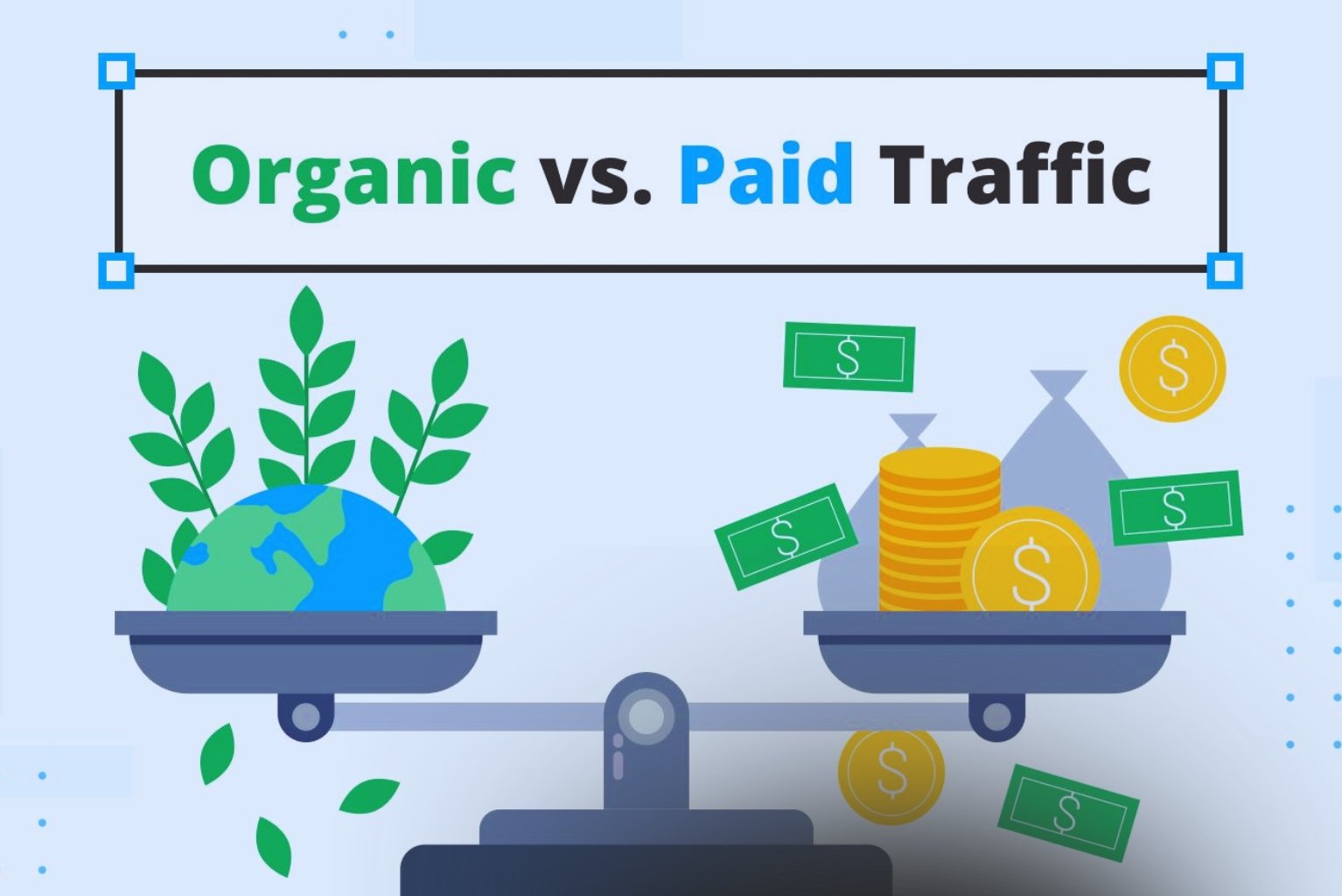
Every small business owner with a limited marketing budget eventually faces the same question: should I invest in SEO or Google Ads?
It’s not a simple question — and anyone who gives you a simple answer without understanding your business, your timeline, and your goals is guessing. Both organic traffic and paid traffic can drive real leads and revenue. But they work differently, cost differently, and deliver results on completely different timelines. Choosing the wrong one first — or splitting a modest budget between both without a clear strategy — can delay growth by months and waste thousands of dollars.
This guide gives you a clear, honest framework for making that decision based on what actually matters: your budget, your timeline, and the ROI you need.
Organic Traffic vs. Paid Traffic: The Core Difference
Organic traffic comes from search engine rankings earned through SEO — the process of optimizing your website so Google displays it prominently when people search for your services. You don’t pay per visitor; you invest in building the authority and relevance that earns those rankings over time.
Paid traffic comes from Google Ads, where businesses bid on keywords and pay per click to appear at the top of search results immediately. Visibility is instant, but it stops the moment your budget does.
Both drive qualified visitors to your website. The difference is in when results arrive, how long they last, and what they ultimately cost per acquired customer.
What Is Organic Traffic? (SEO Explained)
SEO — search engine optimization — is the practice of improving your website’s content, structure, and authority so that Google ranks it higher for the searches your potential customers are already performing.
For a local service business, this means appearing prominently when someone in your area searches for the service you offer. It means showing up in Google’s Map Pack. It means your blog content answering common customer questions drives consistent inbound traffic month after month. It means building the kind of digital authority that compounds over time — where rankings earned today continue delivering leads a year from now without additional spend.
The core benefits of organic traffic for small businesses:
- Long-term visibility that doesn’t disappear when a budget runs out
- Higher trust from users — studies consistently show that organic results are clicked more than ads by users who recognize the distinction
- Lower long-term cost per lead as traffic compounds without proportional cost increases
- Local SEO advantages through Google Business Profile optimization that drive calls and direction requests from nearby buyers
The honest caveat: SEO takes time. For most small businesses in competitive local markets, meaningful organic traffic improvements take 3–6 months of consistent effort, with significant results typically building over 6–12 months. SEO is a long-term asset — not a short-term lead source.
What Is Paid Traffic? (Google Ads Explained)
Google Ads operates on a bidding system. You select keywords relevant to your business, set a maximum cost per click (CPC), and your ad appears at the top of search results when those keywords are searched. You pay only when someone clicks — but in competitive markets, those clicks can be expensive.
The immediate visibility is Google Ads’ defining advantage. A brand-new business with no organic presence whatsoever can appear at the top of Google for its target keywords the day its campaign launches. For businesses that need leads now — not in six months — that speed is genuinely valuable.
The core benefits of paid traffic for small businesses:
- Immediate results from day one of campaign launch
- Precise targeting by location, device, time of day, and search intent
- Scalable campaigns that can be increased or decreased based on performance and cash flow
- Excellent for testing new services, seasonal promotions, or entering new markets quickly
The critical limitation: paid traffic is rented, not owned. The moment your ad spend stops, your visibility stops. There’s no compounding effect — a campaign running for 18 months delivers roughly the same cost per lead on month 18 as it did on month one.
Cost Comparison: SEO vs. Google Ads
Understanding the true cost of each channel requires looking beyond monthly spend to cost per acquired customer over time.
SEO investment for a small business typically includes website technical optimization, ongoing content creation targeting relevant keywords, local SEO management including Google Business Profile, and link building. Professional SEO services for small businesses generally range from $750–$2,500 per month depending on market competitiveness and scope.
Google Ads costs consist of two components: the actual ad spend (what you pay Google per click) and management fees if working with an agency. In competitive local service markets — HVAC, legal, home renovation, medical — CPC rates commonly range from $8 to $40+ per click. A modest local campaign might require $800–$2,500 per month in ad spend alone to generate meaningful volume.
The critical cost difference emerges over 12–24 months. A business spending $1,500/month on Google Ads for two years has spent $36,000 — and owns nothing. Shut off the ads and the leads stop immediately. A business spending $1,500/month on SEO for two years has built a digital asset — rankings, authority, and optimized content — that continues generating leads long after the active investment tapers off. The long-term cost per lead from SEO drops significantly over time; Google Ads cost per lead remains relatively flat indefinitely.
When Should You Invest in SEO First?
SEO is the right primary investment when your situation matches any of these scenarios.
You have a limited long-term budget and need cost-effective lead generation that doesn’t require perpetual ad spend to sustain. You’re in a competitive local market where building authority and consistent organic visibility delivers cumulative advantages over competitors who rely solely on paid advertising. You run a service-based business where local search intent is strong and Google Business Profile optimization can generate calls relatively quickly. You’re planning for long-term growth and want to build a marketing asset that appreciates in value rather than a channel that costs the same indefinitely. You want consistent inbound leads — not traffic that turns on and off with a budget switch.
When Should You Invest in Paid Traffic First?
Google Ads is the right primary investment when your situation looks different.
You’re a brand-new business with no organic presence, no rankings, and no time to wait 6 months for SEO to produce results — you need leads to fund operations now. You have an immediate revenue goal or a seasonal promotion with a defined window where speed matters more than long-term efficiency. You’re testing a new service or entering a new market and want conversion data quickly before committing to a long-term SEO strategy. You’re competing for keywords where organic rankings are dominated by established national players and paid placement is the most realistic path to first-page visibility in the short term.
The Smartest Strategy: Combining SEO and Paid Traffic
For most growth-focused small businesses, the highest-ROI digital marketing strategy isn’t choosing between organic and paid traffic — it’s using both in a coordinated way that maximizes the strengths of each.
The combined approach works like this: launch Google Ads immediately to generate leads and revenue while your SEO foundation is being built in parallel. As organic rankings improve over 6–12 months, reduce paid spend on keywords where you now rank organically — reallocating that budget to more competitive terms or new service areas. Use conversion data from your Google Ads campaigns to identify exactly which keywords drive paying customers, then target those same terms with SEO content to capture organic traffic for free over time.
Add retargeting campaigns that serve ads specifically to visitors who found your site organically but didn’t convert on the first visit — and you have a system that captures demand at every stage of the buyer journey, maximizes the ROI of both channels, and steadily reduces cost per acquisition as organic authority grows.
Real-World Example: Three Approaches, Three Outcomes
Consider a San Diego home services company with a $2,000 monthly marketing budget. Three different strategic choices produce three very different outcomes over 18 months.
Scenario A — Google Ads only: Leads start immediately, averaging 25–30 per month at a cost per lead of roughly $65–$80. Revenue is consistent but entirely dependent on continued ad spend. After 18 months, the business has spent $36,000 and has no organic presence to show for it. Reduce the budget and leads drop proportionally.
Scenario B — SEO only: Months 1–4 produce minimal leads as rankings build. By month 6, organic leads begin arriving. By month 12, the site ranks for multiple local keywords and generates 20–35 leads per month at a cost per lead that has dropped to $40–$50 and continues falling. By month 18, the cost per lead is under $30 and declining. The business has built a lasting digital asset.
Scenario C — Combined strategy: $1,200 to Google Ads for immediate leads during months 1–6; $800 to SEO simultaneously. By month 6, organic leads supplement paid volume. By month 12, SEO is generating 15–20 organic leads per month, allowing paid budget to be reduced and reallocated. By month 18, the combined cost per acquisition is the lowest of all three scenarios, and the business has both immediate lead flow and a growing organic asset. This is the scenario that most consistently delivers the best long-term ROI.
Common Mistakes Small Businesses Make
Even with the right channel selection, execution errors undermine results consistently.
Expecting SEO to produce leads within 30 days leads to premature abandonment — just before the compounding returns would have materialized. Running Google Ads to an unoptimized homepage rather than a dedicated landing page wastes a significant portion of ad spend on clicks that bounce without converting. Not tracking conversions means budget decisions are based on impressions and clicks rather than actual leads and revenue. Stopping SEO after 3–4 months because results feel slow means never reaching the threshold where rankings deliver consistent, low-cost organic leads. And ignoring local search optimization — particularly Google Business Profile — means missing the Map Pack, where a large share of local service clicks actually go.
Budget Planning: How Much Should You Invest?
General budget guidance by business stage helps frame realistic expectations.
Small local businesses with monthly revenue under $50,000 should generally allocate $750–$1,500/month — prioritizing local SEO and a modest Google Ads campaign focused on their highest-value service.
Mid-size service businesses generating $50,000–$200,000 per month typically benefit from $1,500–$4,000/month split between SEO, Google Ads, and landing page optimization — with budget allocation shifting toward SEO as organic rankings build.
Growth-focused companies targeting aggressive expansion should consider $4,000–$10,000+/month in combined digital marketing investment, with a sophisticated strategy integrating SEO, paid search, retargeting, and conversion optimization working as a unified system.
The most important principle regardless of budget: allocate strategically based on your timeline and goals, track every dollar to actual leads and revenue, and optimize continuously rather than setting and forgetting.
About Apps Web Dev LLC
Apps Web Dev LLC is a San Diego-based full-service digital marketing agency specializing in SEO strategy, Google Ads management, conversion rate optimization, and landing page design for small businesses across the United States. Their data-driven approach to digital marketing strategy focuses on one outcome: measurable ROI for every client, regardless of budget size.
From building organic search authority to managing high-performance paid campaigns, Apps Web Dev LLC delivers integrated strategies that generate consistent, scalable lead generation for small businesses ready to grow.
Stop Guessing — Start Investing Strategically
Every month without a clear digital marketing strategy is a month of potential leads going to competitors who figured it out first.
Apps Web Dev LLC offers a free traffic and ROI analysis for qualifying small businesses. Their team will review your current organic presence, assess your paid advertising opportunities, and deliver a custom SEO and Google Ads strategy built around your specific budget, market, and revenue goals.
Frequently Asked Questions
Is SEO better than Google Ads for small businesses?
Neither is universally better — the right choice depends on your timeline, budget, and goals. SEO delivers compounding, long-term organic traffic that builds in value over time and eventually produces a lower cost per lead than paid advertising. Google Ads delivers immediate visibility and leads but stops producing the moment you stop paying. For businesses with a 6–12 month runway and stable cash flow, SEO offers superior long-term ROI. For businesses needing leads immediately or testing a new market, Google Ads is the faster path. The strongest strategy for most growth-focused small businesses combines both channels strategically.
How long does SEO take to work?
Most small businesses begin seeing measurable organic traffic improvements within 3–6 months of consistent, professional SEO work. Reaching competitive first-page rankings for high-value keywords typically takes 6–12 months depending on market competition, domain age, and the quality and consistency of the strategy. Local SEO results — particularly Google Business Profile visibility and Map Pack rankings — often appear faster, sometimes within 6–8 weeks of targeted optimization. The businesses that commit to a 12-month SEO strategy consistently outperform those that abandon efforts after 60–90 days without seeing the immediate results they expected.
How much should a small business spend on Google Ads?
A realistic starting budget for Google Ads is $500–$1,500 per month in ad spend for small local businesses, plus agency management fees if applicable. Highly competitive industries — legal, medical, home services, financial — typically require $2,000–$5,000/month to compete effectively in local markets. The more important metric than budget size is cost per acquired customer: how much are you paying in total ad spend for each new paying client? A well-managed $1,000/month campaign with optimized landing pages and precise targeting will consistently outperform a poorly managed $3,000/month campaign. Always optimize for conversions, not clicks.
Can I run SEO and paid ads at the same time?
Not only can you — for most growth-focused small businesses, running both simultaneously is the smartest digital marketing strategy available. Google Ads delivers immediate leads while SEO builds long-term organic authority in parallel. Paid campaign data reveals which keywords drive actual conversions, informing exactly where to focus SEO content efforts. As organic rankings improve, paid budget can be reallocated from covered keywords to new opportunities. The two channels reinforce each other when managed with a unified strategy — producing better combined ROI than either channel delivers independently.
Which generates better ROI: organic or paid traffic?
Over a 12–24 month horizon, organic traffic from SEO typically delivers a higher return on investment for most small businesses. Once rankings are established, traffic costs nothing per click — resulting in a steadily declining cost per lead as authority compounds. Google Ads delivers more predictable, consistent ROI but doesn’t improve over time; cost per lead remains relatively flat regardless of how long campaigns run. For businesses with limited budgets and a long-term growth mindset, SEO offers the stronger ROI over time. For businesses prioritizing speed and immediate measurable returns, Google Ads provides faster, more controllable results in the short term.